Why great companies stay invisible, and how to fix it
Quality rarely sells itself. The businesses that win are not always the best; they are the best understood. This is the strategy behind brands that get noticed.
Almost every founder we meet believes the same thing at the start: if the product is good enough, customers will find it. It is a generous belief, and it is usually wrong.
Buyers make decisions with limited time and limited attention. They choose what they understand quickly, what they have heard of, and what feels safe. A competitor with a clearer story and a louder presence will beat a better product with a vague one, again and again.
This is the gap Phibuzz was founded to close: exceptional businesses held back not by what they offer, but by how little the market knows about it.
The four reasons good brands go unnoticed
1. They describe what they do, not why it matters
"We manufacture precision components" is a fact. "We help medical device makers launch faster with zero-defect components" is a reason to call. Most websites list capabilities when buyers are looking for outcomes.
2. They try to speak to everyone
A brand that is for everyone is remembered by no one. Strong brands choose a primary audience and speak directly to its problems, language and ambitions.
3. They are inconsistent
A sharp website, an outdated LinkedIn page, a different logo on the brochure and a third description in the Google listing. Every inconsistency costs trust, and in the age of AI search it also confuses the systems that recommend you.
4. They have a story but no distribution
Even the best narrative fails if it only lives on your website. Reach is a strategy in its own right: the right audiences, platforms and partners, repeated often enough to be remembered.
The strategy behind brands that get noticed
The brands that break through tend to follow the same sequence:
Position. Decide who you serve best, what you solve and why you are the obvious choice. Write it in one sentence your whole team can repeat.
Prove. Collect the evidence: results, case studies, testimonials, certifications, numbers. Positioning without proof is just a claim.
Package. Turn the story into an identity and messaging system: visual identity, tone of voice, key messages and a library of assets.
Publish consistently. Show up with the same story across your website, search, social, sales materials and the personal brands of your leaders.
Distribute. Put the story in front of the right people at scale through search, paid media, creators, PR and content distribution networks.
A quick self-test
Answer these honestly:
Could a new customer explain what you do and why you are different after ten seconds on your homepage?
Do your website, LinkedIn, Google profile and sales deck tell the same story?
When someone asks an AI assistant for a recommendation in your category, is your name in the answer?
Do people outside your existing network see your brand at least once a month?
If you answered "no" to two or more, the problem is probably not your product.
Frequently asked questions
Is branding only for consumer companies?
No. B2B companies, manufacturers and textile exporters often gain the most from clearer positioning, because their buyers compare many similar suppliers.
How long does it take to see the impact of brand strategy?
Clarity improves sales conversations immediately. Market awareness builds over months as the new story is distributed consistently.
Next step
If your business is better than its brand, let's fix that. Book a free brand perception review with Phibuzz.
The Phibuzz Editorial Team brings together our brand strategists, SEO and AI search specialists, performance marketers and event marketing leads in Mohali, India and Ajman, UAE. We write from hands-on work with 150+ clients across healthcare, AI and technology, textiles, manufacturing, B2B and D2C, and we research every date, rule and figure against official sources before publishing.
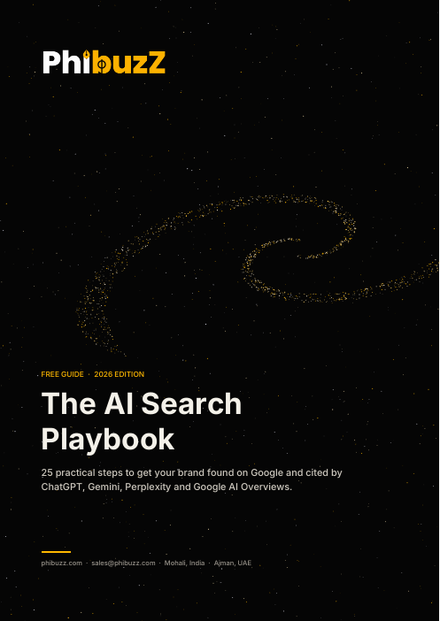
25 practical steps to get your brand found on Google and cited by ChatGPT, Gemini, Perplexity and Google AI Overviews. An 8-page PDF checklist with a self-scoring system.
Foundations, content, authority, technical and measurement
Spending on ads before your positioning is clear is like amplifying a message nobody understands. Here is the framework we use to define what a brand stands for before a single campaign runs.
The Gulf is one of the most digitally connected regions in the world, and one of the most competitive. Here is what we see working for brands in the UAE, Saudi Arabia, Qatar and beyond.
Brands are producing more content than ever, and most of it reaches almost no one. In 2026, how you distribute a story matters as much as how you tell it.